



Disconnection Between Self-Reported Wellbeing and Heart Rate Variability from Wearables
Published
February 2026
Author
Ungaro CT, Wolfe AS, Isaacs ZJ, De Chavez PJD, Freese EC
Topics

Abstract
Study Objective: To assess the association between daily self-reported emotional and mental readiness and their association with overnight resting heart rate variability. Methods: Participants included 21 males (32 ± 7 years) and 18 females (28 ± 4 years). Activity tracker data were collected for three months, measuring heart rate variability, resting heart rate, sleep time, sleep efficiency, bed/wake times, steps counted, and daily self-reported caffeine use, alcohol use, hydration, feelings on stress, illness, motivation, energy, nervousness, emotional stability, and recovery. Results: Self-reported stress and nervousness did not have an association with heart rate variability (Stressed HRV 63.5 ± 0.6 vs. Not Stressed HRV 63.1 ± 0.5 ms, p = 0.63) and (Nervous HRV 62.9 ± 0.9 vs. Not Nervous HRV 63.7 ± 0.4 ms, p = 0.41). Self-reported feelings of being energized had a negative association with heart rate variability (Energized HRV 64.1 ± 0.4 vs. Not Energized 66.9 ± 0.8 ms, p < 0.01). Conclusions: Subjective feelings of readiness may not correspond to activity tracker biometrics and should be taken into consideration when calculating readiness scores and providing personalized recommendations based on HRV. Caution should be taken when using HRV-based recommendations to guide a user’s health and wellness journey.
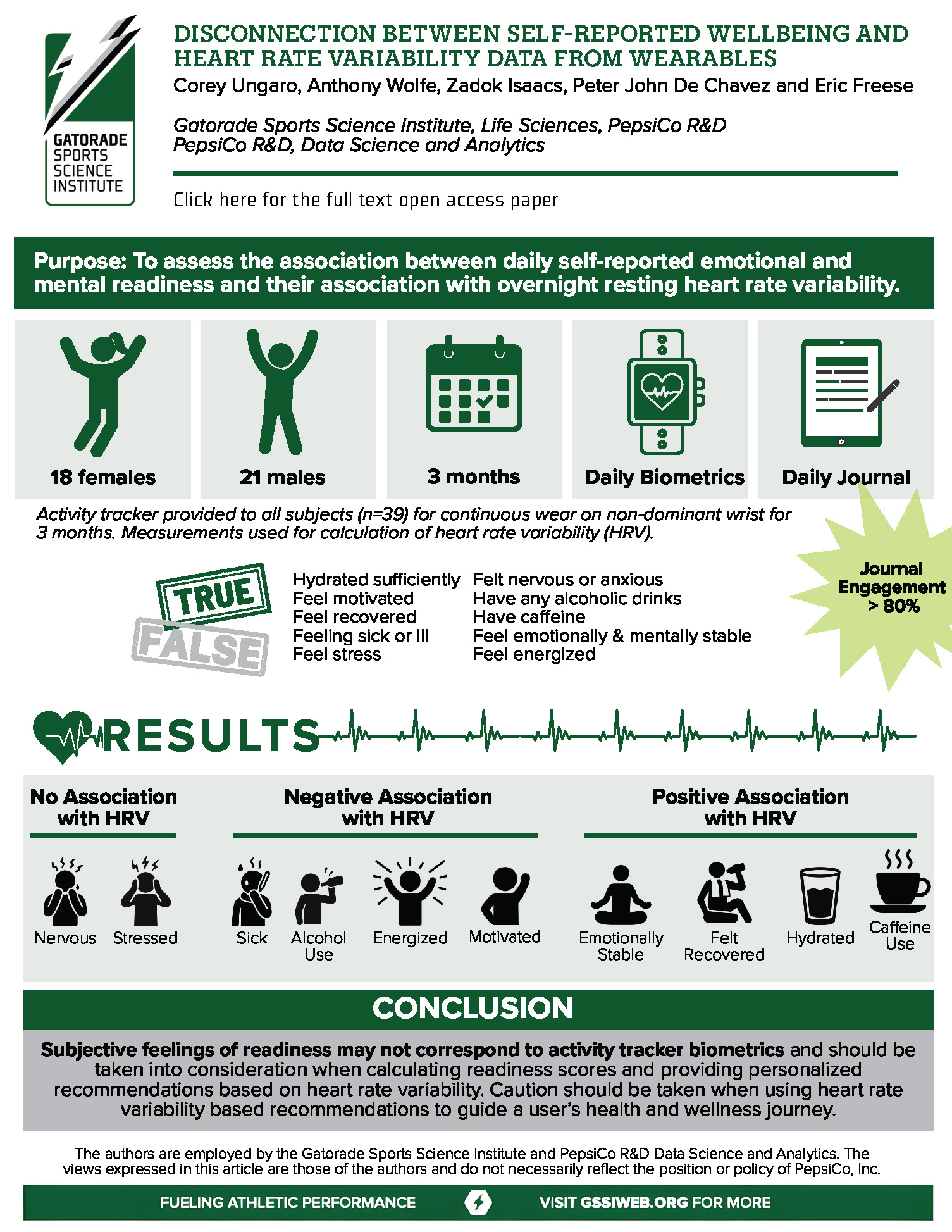
To download this infographic, click here
Sensors (2026) 26(4) 1325